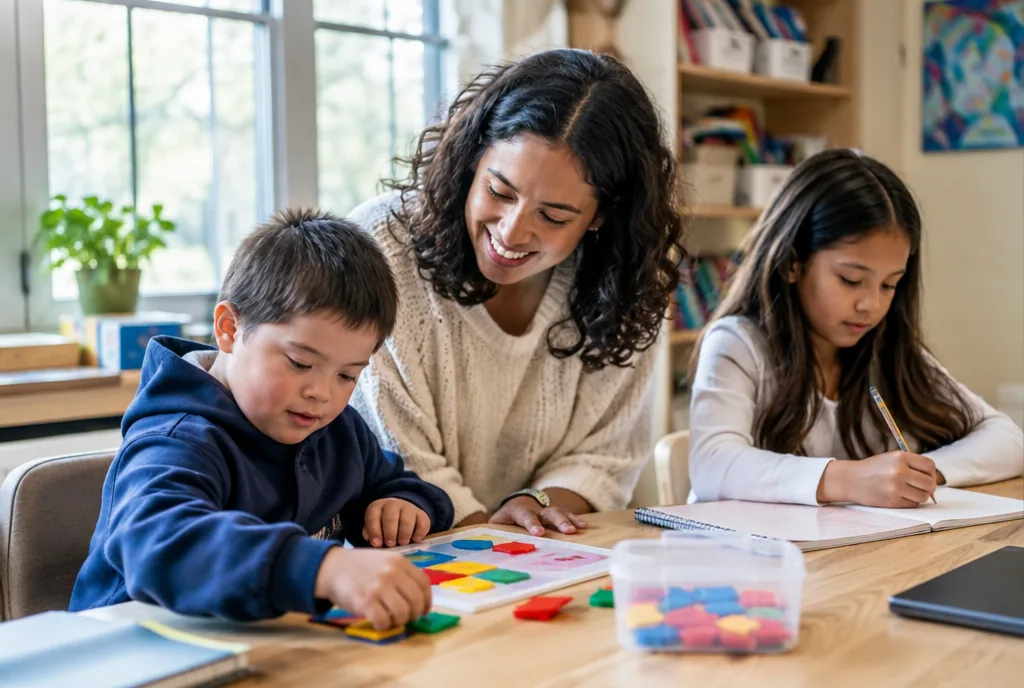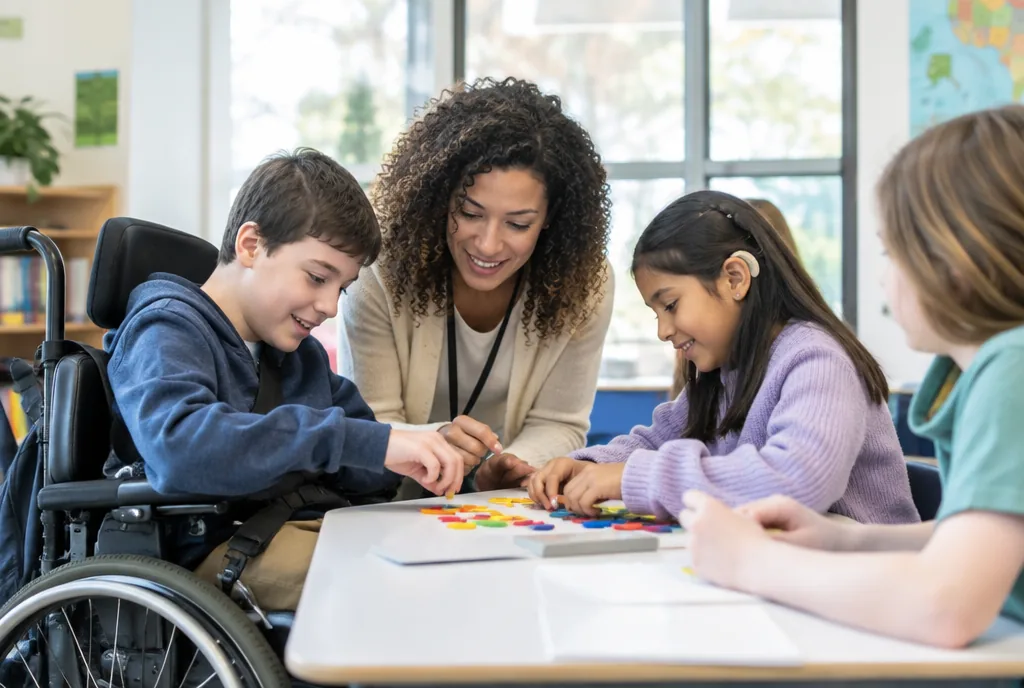
The children learn the date and the days that make up the week, though they do not always remain sitting in the same spot all day. This routine belongs to Joan Radigan's class at Public School 295 in Greenwood Heights, Brooklyn. One day while they were working on the calendar, an interruption forced Ms. Radigan to step away from the group. A boy rose and walked to the door, so she followed him back and returned him to the rug — something she had done before.
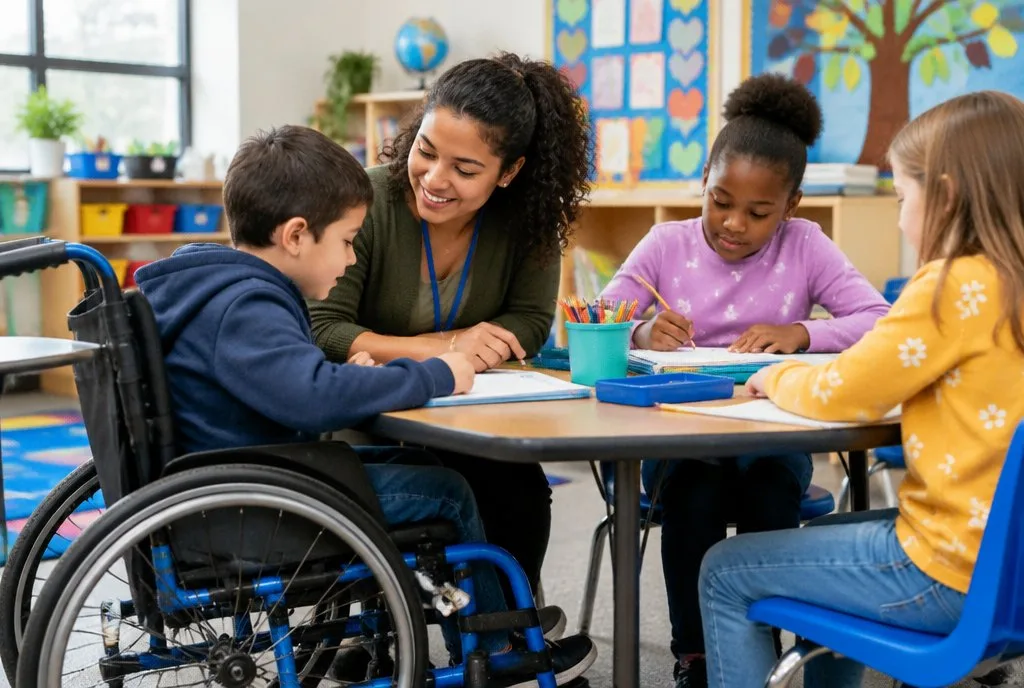
Supported by two trained classroom assistants, Ms. Radigan cares for this boy and his ten classmates at P.S. 295. Their needs go beyond basic lessons: these children require added patience and tailored support because they have autism spectrum disorders and learning disabilities. Ms. Radigan monitors their progress with the goal of moving them into general education classrooms next year.
P.S. 295 does not typically separate typical students from those with special needs; instead, children are usually placed together so teachers can distribute attention more evenly. Educators refer to this approach as inclusion. When many students in Ms. Radigan's inclusion class did not reach expected gains, staff decided to create a separate class for students with special needs, a change many observers see as a temporary fix and a significant backward step.
A study found roughly 165,000 special education students, and more than one-third of them spend much of the school day in separate classes. That rate of separate placement is higher than in Chicago and Los Angeles. Some experts worry that options short of full inclusion can harm special education students and contribute to low graduation rates; in New York City only about 30% of special education students graduated in four years, below the citywide average.
Julie Causton-Theoharis, assistant professor of teaching at Syracuse University noted that schools in other districts from Concord, New Hampshire to Charlotte, North Carolina now have trained staffs in a fully-inclusive classroom for special Ed students. Though they found out that the test scores for children who have undergone fully-inclusive classes have went up, city officials still believe that principal training and flexibility are the core to their continuous efforts to recondition the special education practices.
Ms. Deana Marco, principal of P.S. 295 is among those 265 school principals and teachers getting extra course through the Education Department's new reform effort to serve every child in the neighborhood school. She believes that it will be a big change and progress will not be impossible knowing that a child could be sent to another school if no progress has ever been attained from the other. There have been a lot of debates and studies regarding full inclusion and a few local public schools have already shifted towards it ans Queens and P.S. 396 in the Bronx are among those.
There have been a lot of positive and negative reactions from academic officers all over the place. Shael Polakow-Suransky, New York City's chief academic officer said that it all depends on the budget. Given enough funds, they could have more training and options like bringing a specialist into the regular class or pulling a child out of class for a certain period of reading help. Ms. Radigan stands by her school's decision, giving the kindergartens and first-graders an extra year with her. She expects that the students will later on be geared up to join a regular class next fall. She is quite confident that the outcome will be positive especially when the changes in special education go citywide.