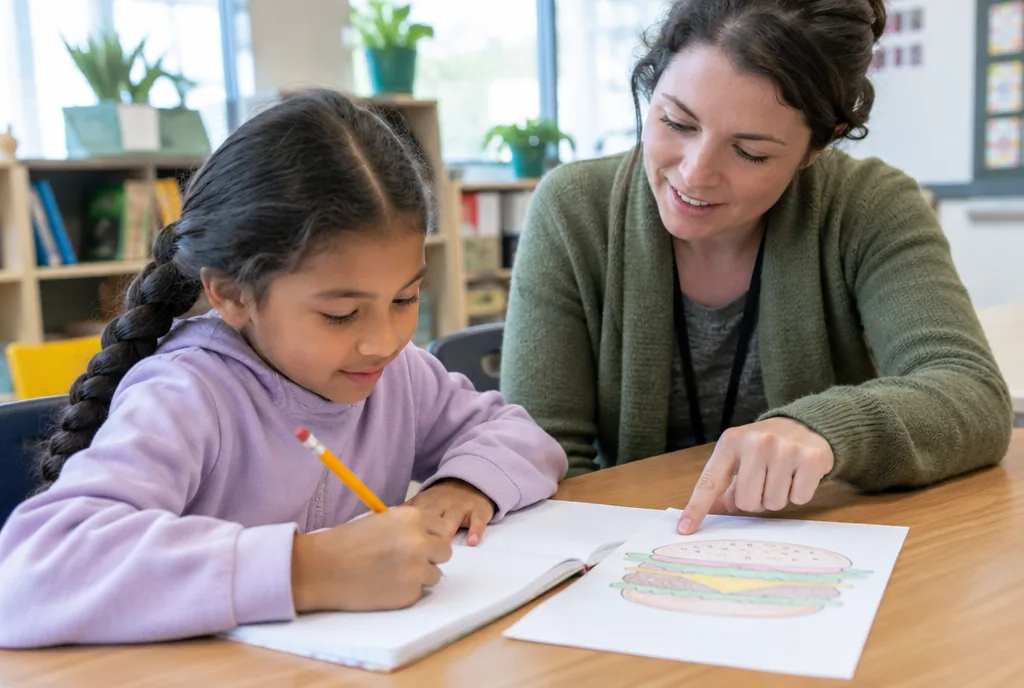
A hamburger paragraph is a visual way to build one clear piece of writing: a topic sentence is the top bun, at least three supporting details are the fillings, and a closing sentence is the bottom bun. For a student staring at a blank page, that picture turns “write a paragraph” into a sequence of manageable choices. It also gives parents and teachers a quick way to spot what is missing: an unclear main idea, thin support, or an ending that wanders into a new topic.
What the Hamburger Paragraph Method Makes Visible
At its core, the hamburger paragraph method is a graphic organizer for the three core components of a paragraph. The topic sentence comes first. It names the paragraph’s main idea and tells the reader what to expect. In the middle are the detail sentences: evidence, examples, explanations, or facts that support that idea. At the bottom is the closing sentence, sometimes called a clincher. It restates the point in fresh words or creates a bridge to the next paragraph.
The image matters because a student can see that a paragraph needs more than a first sentence and a list of unrelated thoughts. Every filling should connect to the top bun. A precise topic sentence such as “Recess can help students focus during afternoon lessons” gives the writer room to explain why. “Dogs are animals” is too broad; “My dog Fido ate a sock last Tuesday” is too narrow for a full paragraph.
In some classrooms, this method goes by other names, including the hamburger technique, paragraph hamburger, Oreo paragraph, and evidence sandwich. Whatever the name, the useful habit is the same: make the claim, develop it, and close it.
Use a Hamburger Paragraph Template Before You Draft
Before drafting, use a hamburger paragraph template to plan instead of trying to make polished sentences at once. Whether you use paper, a simple table, or a hamburger-shaped graphic organizer, give each space one job. That separation helps students organize ideas and notice the relationship between their main point and their support.
| Layer | What to plan |
|---|---|
| Top bun | One precise topic sentence stating the main idea. |
| Filling 1 | A first fact, example, piece of evidence, or explanation. |
| Filling 2 | A second supporting detail that adds to the idea. |
| Filling 3 | A third detail or elaboration. |
| Bottom bun | A closing sentence that summarizes, reinforces, or bridges—without new information. |
If complete sentences feel like too much, start with notes. For a paragraph about recess, a student might list “outside,” “move,” and “calmer” in the three middle spaces, then turn each note into a sentence. Beyond the basic version, a planning diagram can include the topic, point of view, verb tense, sequence, and transition words. Think of the organizer not as the finished writing but as the plan that makes drafting less mysterious.
Write a Strong Paragraph in Four Deliberate Moves
Use the hamburger structure as a repeatable routine, then adapt it to the assignment. For planning, the University of Kansas Paragraph Writing Strategy uses the mnemonic PENS: Pick a topic, Enumerate ideas, Note transitions, and Sequence them by time or order. Together, those actions fit naturally with the hamburger model.
- Write the top bun. In the first sentence, state the topic and the main point.
- Gather three fillings. Add at least three details that prove, illustrate, or explain that point.
- Connect the fillings. Put the details in an order the reader can follow, and use transition words where they help.
- Add the bottom bun. At the end, restate the idea, draw a conclusion from what is already there, or lead into the next paragraph.
For sequence, try first, second, third, next, then, and finally. To add support, try for example, in addition, also, furthermore, or moreover. For a closing, use therefore, thus, or as a result if helpful, but do not rely on a stock phrase. For students with reading difficulties, signal words make the text structure easier to recognize.
In a short paragraph, an explicit closing sentence can be unnecessary if it only repeats the first sentence. In a longer paragraph, however, use a purposeful bottom bun to keep the reader oriented. Never introduce a fresh fact there that needs its own explanation.
See Every Layer Work in a Park Paragraph
Before revising, let a younger writer label this simple example:
There are many things I can do at the park. First, I can talk to my friends and tell funny stories. Second, I can run and exercise with my friends. Third, I can bring my little brother to swing on the swings. In conclusion, the park is a wonderful place to spend the afternoon.
The first sentence is the top bun: it introduces the idea of activities at the park. The next three sentences are the fillings, and each offers one specific activity. The final sentence is the bottom bun; it returns to the overall point without adding another activity. Once a student can label the parts, ask a more useful revision question: do all three middle sentences really support the topic sentence? That question moves the work from filling boxes to building coherence.
Teach the Pattern Until Students Can Use It Alone
Teach the structure through gradual release of responsibility rather than handing over a blank organizer and hoping it works. First, model a paragraph and think aloud as you decide which details belong. Next, write one together as a class. Then let partners plan and draft before students write independently. This order gives students rehearsal before they are expected to manage every choice alone.
- Day 1: Introduce the top bun, fillings, and bottom bun.
- Day 2: Model planning and writing a paragraph.
- Day 3: Write a paragraph together as a class.
- Day 4: Have partners use the organizer and give feedback.
- Day 5: Ask students to write independently.
Give younger students and English learners prepared sentence parts to sort into a logical paragraph. You can also ask them to identify and rewrite paragraphs from textbooks. Before writing, let a hesitant writer say a “Talking Essay” aloud to a partner, then capture the ideas as notes. Sentence starters such as “My first reason is …” and “Another example is …” reduce cognitive load, so attention can stay on meaning and order.
Differentiate Support Without Lowering the Thinking
To practice the same paragraph-writing skill, students do not need identical materials or identical products. Differentiate content by giving students texts of different complexity on the same topic. One student may work from a simpler reading while another uses a more complex one; both still select details and explain how they support a topic sentence.
Vary the process as well. One writer may complete the entire template, while another receives the top and bottom buns and adds only the fillings. For the final product, students can show their organized thinking in written text, an audio recording, or a poster with graphics. Across these choices, the central task remains: develop one idea in a clear order.
For students with learning disabilities, this explicit, step-by-step support is particularly relevant. The University of Kansas tested its Paragraph Writing Strategy, built on this basic structure, with more than 200 students with learning disabilities. In one study of seven high school students with learning disabilities, average scores for well-organized paragraphs rose from 36% at baseline to 80% after instruction. The larger lesson is that a picture does not solve writing by itself: students need modeling, practice, feedback, and chances to use the strategy beyond the support setting.
Use the Hamburger Essay as a Map, Not a Cage
For an essay, expand the paragraph image. The top bun becomes the introduction, the filling becomes the body paragraphs—usually three—and the bottom bun becomes the conclusion. In this familiar 1-3-1, or five-paragraph, essay model, place a lighter point first and reserve the strongest point for the end of the filling.
That structure is a useful beginning, not a permanent rule. As assignments become more complex, paragraph lengths and conclusions can vary. At the university level, introductions and conclusions should take up only about 10–15% of the full paper. The model remains valuable when it helps a writer see the overall shape, then gets out of the way when the subject needs more developed reasoning.
Three Myths That Can Flatten a Good Paragraph
- “The formula is a permanent rule.” It is a temporary scaffold. Writers can later vary paragraph lengths, add sections, and shape conclusions for the task.
- “Every ending must start with ‘In conclusion.’” A closing can summarize or bridge naturally. Its real job is to avoid introducing a new idea at the last second.
- “Evidence is enough for the filling.” Evidence needs explanation. Stacking quotations or facts without saying how they support the topic sentence creates the common “quote trap.” Analysis should make up much of the middle.
Frequently Asked Questions
What is the hamburger paragraph?
It is a visual paragraph-writing organizer: a topic sentence is the top bun, at least three detail sentences are the fillings, and a closing sentence is the bottom bun.
How do you write a hamburger paragraph?
Write a precise topic sentence, add three details that support it, connect them in a sensible order with transition words where useful, and finish with a summary or bridge that adds no new information.
How do you write a hamburger essay?
Use the introduction as the top bun, usually three body paragraphs as the filling, and the conclusion as the bottom bun. Start with a lighter argument and build toward the strongest one.
How do you teach it to students?
Model the process, write together as a class, move to partner practice, and then assign independent writing. A five-day sequence can introduce parts, model, practice together, use partners, and end with independent work.
Why can this method help students with learning disabilities?
It breaks paragraph writing into visible parts and supports explicit, gradual instruction. Organizers, oral rehearsal, sentence starters, practice, and individual feedback can make planning and drafting more manageable.