Self advocacy is the ability to understand your own strengths and needs, know your rights, and speak up to get the support you need. For a student with a disability, it can be as simple as asking to have directions repeated or as big as leading their own IEP meeting and requesting accommodations in college. A simple self advocacy definition: knowing yourself, knowing what you need, and knowing how to ask for it.
What is self-advocacy?
The term comes from the self-advocacy movement, in which people with intellectual and developmental disabilities organized to speak for themselves instead of having others speak for them. Groups such as People First and Self Advocates Becoming Empowered spread the idea that people with disabilities are the experts on their own lives. For many self-advocates, speaking up is also a source of pride and community.
In schools, the term refers to a set of skills that students build over time. It is closely linked to self-determination, which means making choices, setting goals, and taking charge of one's own life. Speaking up is the communication side of that: telling others what you need in a clear, respectful way.
Why self-advocacy matters for students with disabilities
In elementary school, parents and school staff do most of the advocating. Parents request evaluations, attend IEP meetings, and push for services. As students get older, adults step back, and students need to handle more on their own. Students who can speak for themselves tend to use their accommodations without waiting for an adult, ask for help before small problems grow, and feel more confident and in control. For many students with learning disabilities, speaking up is a key part of being successful in school.
These skills matter most at the end of high school. Under the Individuals with Disabilities Education Act (IDEA), rights that belong to parents may transfer to the student at the age of majority set by state law, usually 18. The IEP must state, at least one year before that age, that the student has been told about this transfer. After graduation, the student is the one who has to ask for support.
Core self advocacy skills: strengths, rights, voice, and leadership
Knowing yourself
Everything starts with self-awareness. Students learn their strengths, interests, and learning style, as well as the challenges linked to their condition. A student with dyslexia might say, "I understand ideas quickly when I listen, but reading long passages takes me longer." A student with ADHD might explain that short breaks help them focus.
Knowing your rights
Students should know, in plain terms, which laws protect them. In K–12 schools that includes IDEA and Section 504. After high school, Section 504 of the Rehabilitation Act and the Americans with Disabilities Act (ADA) apply. Students do not need to be legal experts, but they should know their basic legal rights and where to go if they face discrimination.
Communication skills
This is the part most people picture: asking for help clearly and politely. It includes choosing the right person and time, explaining the need briefly, suggesting a solution, and following up. For students who use AAC, it may mean using their device, a script, or a prepared card.
Leadership
Leadership means taking an active role in planning: setting goals, running part of a meeting, joining a youth advisory group, or helping peers find their own voice.
Practice self-advocacy in student-led IEP meetings
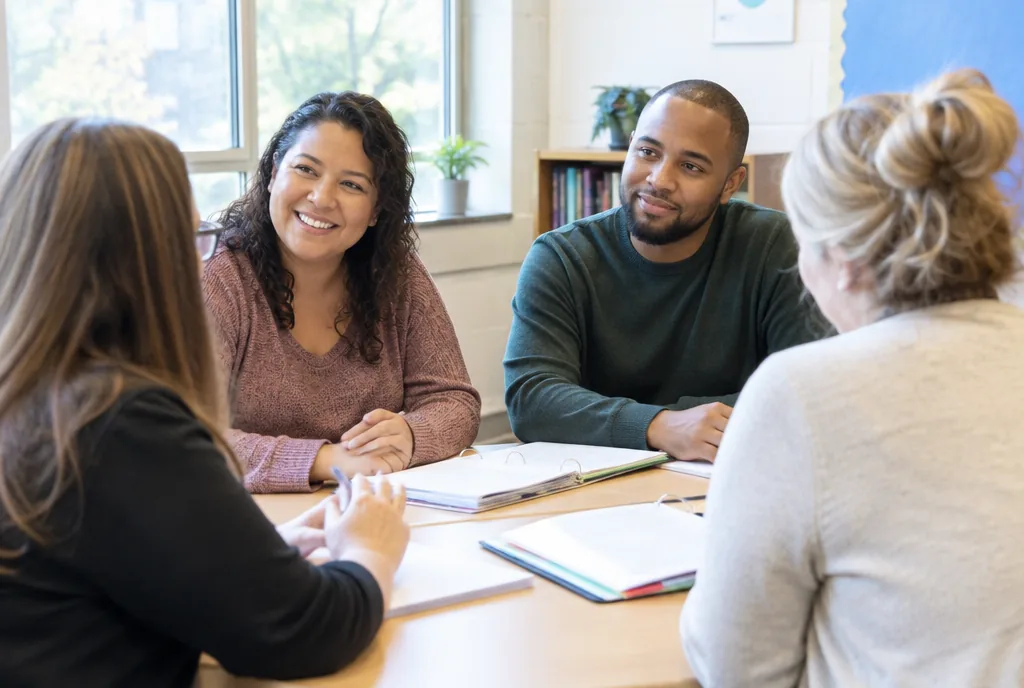
A student's own IEP meeting is one of the best places to build these skills. IDEA requires schools to invite the student to any IEP meeting where postsecondary goals and transition services are discussed, and many teams include students much earlier. Involvement can grow step by step:
- Attending the meeting and listening
- Sharing one or two strengths and interests
- Explaining which supports help and which do not
- Helping draft goals, including those in the individualized transition plan
- Leading the meeting: introducing the team, reviewing present levels, and summarizing next steps
A one-page profile or short slide show can help the student prepare. Person-centered planning tools are another good way to gather the student's own goals before the meeting.
Teaching self advocacy: how to teach your child at different ages
Teaching self advocacy works best when it starts early and builds over time. The ideas below are examples, not a fixed timeline.
- Early elementary: Practice naming feelings and asking for a break. Model simple phrases such as "I don't understand" or "Can you show me again?" Praise the child for asking for help.
- Upper elementary and middle school: Talk openly about the child's needs using accurate, positive words. Review the IEP or 504 plan together. Use role-playing to rehearse asking for extended time in different situations.
- High school: Have the student lead or co-lead IEP meetings, email staff to request accommodations, brainstorm solutions when something is not working, and discuss the transfer of rights at 18.
Encourage the student to try before an adult steps in, and treat mistakes as part of learning. When a student needs extra help, the IEP team can write measurable goals for these skills.
The transition to college: no IEP, new rules
IEPs do not follow students to college. IDEA ends when a student graduates with a regular high school diploma or ages out. Colleges are covered by Section 504 and the ADA instead. According to the U.S. Department of Education's Office for Civil Rights, key differences include:
- The student must ask. Colleges do not have to find students with disabilities. The student contacts the disability services office.
- Documentation is required. Colleges may ask for documentation, and an old IEP or 504 plan may not be enough on its own.
- Adjustments, not special education. Colleges must provide appropriate academic adjustments, such as extended test time, but do not have to lower or change essential course requirements.
- Parents are not automatically involved. The student is the main contact.
A student who can explain their needs, describe what helps, and follow up with professors is much better prepared for this change. The same skills help at work, where employees can request reasonable accommodations under the ADA.
How to help your child build effective self-advocacy
Parents and teachers play a supportive role in the development of self-advocacy skills. Some ways to work on them at home and in the classroom:
- Help your child describe their strengths and talents, not only their challenges.
- Encourage your child to tell others what they need in their own words, whether verbal or written.
- Brainstorm a solution together before a hard conversation, then let the child take the lead.
- Recognize and value every attempt, even when the outcome is not perfect.
- Talk with the school counselor, a helpful resource for planning life after high school graduation.
Effective self-advocacy is a life skill. Students who learn to speak up confidently and assertively, while staying respectful, are better prepared to navigate college, work, and community life.
Frequently asked questions about self-advocacy
What does self-advocacy mean?
It means speaking up for yourself: understanding your needs, knowing your rights, and telling others what you need to succeed. It empowers people to take the lead in decisions about their own lives.
What is an example of self-advocacy?
Asking to take a test in a quiet room, explaining your learning needs to a new teacher, leading part of your IEP meeting, or contacting a college disability services office are all examples.
What are the main self advocacy skills?
Most programs name four: knowing yourself, knowing your rights, communicating your needs, and leadership.
Can self-advocacy be an IEP goal?
Yes. If a student needs to build these skills, the IEP team can write specific, measurable goals, such as explaining supports to staff or taking part in the IEP meeting.
Does my IEP carry over to college?
No. Students in college are protected by Section 504 and the ADA, but they must disclose their disability to the college and request accommodations themselves.