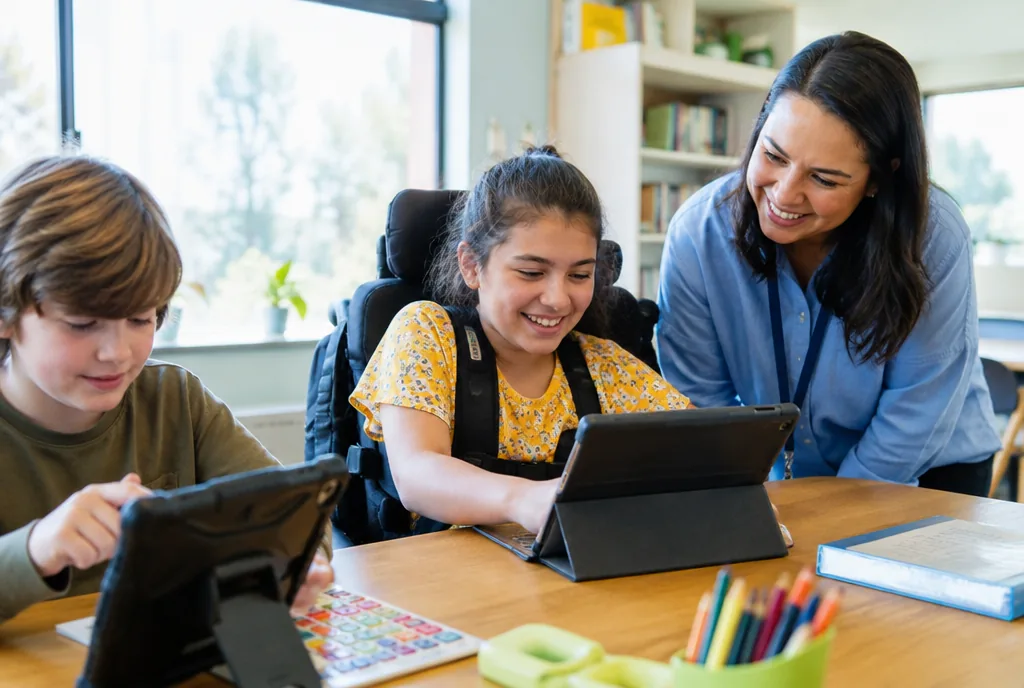
AT stands for Assistive Technology. In the realm of special education, Assistive Technology encompasses any device, piece of equipment, or software system used to increase, maintain, or improve the functional capabilities of a student with a disability.
What is Assistive Technology?
For many students with disabilities, the standard tools of a classroom—like printed textbooks, standard pencils, or a traditional computer keyboard—present massive physical or cognitive barriers to learning. Under the federal IDEA law, schools are required to provide a FAPE, meaning they must remove these barriers. Assistive Technology is often the bridge that connects a child to their education.
AT is not a luxury or a special favor; it is a legally mandated service if the IEP team determines it is necessary for the student. Importantly, the law categorizes AT into two parts: the "device" itself and the "service." This means the school district is not only responsible for buying the device, but they are also legally required to train the student, the teachers, and even the parents on how to properly use and maintain it.
Low-Tech vs. High-Tech AT
When parents hear the word "technology," they often envision expensive computers or complex robotics. However, in special education, Assistive Technology spans a massive continuum from very simple, inexpensive items to highly complex digital systems.
- Low-Tech AT: These are simple, non-electronic items that require no training to use. Examples include a molded plastic pencil grip to help a child with dysgraphia hold their pencil, a slant board to angle papers upward, a highlighter tape used to mark important sentences in a book, or a visual schedule printed on laminated paper.
- Mid-Tech AT: These are relatively simple electronic devices that may require batteries but are not highly complex. Examples include audiobooks, simple digital timers to help with time management, a basic calculator, or a spelling dictionary device.
- High-Tech AT: These involve sophisticated computers, specialized software, or intricate electronics. Examples include text-to-speech software that reads textbooks aloud for a student with dyslexia, speech-to-text dictation programs, eye-tracking software that allows a paralyzed student to control a computer cursor, or a specialized AAC (Augmentative and Alternative Communication) iPad app that a non-speaking student uses to generate verbal speech.
How a student qualifies for AT
Assistive Technology must be explicitly considered at every single annual IEP meeting. During the development of the IEP, federal law requires the team to formally ask and document whether the child needs assistive technology devices and services to access their education. If the parents or teachers believe AT is necessary but they are unsure which device is best, the school should conduct a formal Assistive Technology Evaluation.
This evaluation is usually conducted by a specialized AT professional or a trained SLP or OT. They will observe the student, trial several different devices, collect data on which one works best, and then write a recommendation for the IEP team to implement.
The school's legal responsibility
If the IEP team agrees that a specific AT device is necessary for the child to receive a FAPE, the school district must provide it entirely at public expense. The school cannot force parents to use their private health insurance to buy an iPad or a communication device if it is required for school, nor can they ask the parents to pay for repairs if the device breaks during normal use.
Furthermore, if the IEP team determines that the student needs the device at home to complete homework, to communicate with their family, or to practice their skills, the school district must allow the device to go home with the student. Many schools resist this, fearing the equipment will be broken or lost, but federal guidelines are clear: if home use is required for FAPE, the device must travel with the child.
What parents can do
If you believe your child is struggling because they cannot physically access the curriculum or communicate effectively, request a formal Assistive Technology evaluation in writing. Do not just ask for "an iPad"—ask for an evaluation to find the best tool for your child's specific needs.
When AT is written into the IEP, make sure the document is highly specific. It should not just say "the student will use a communication device." It should specify the exact type of device, the exact software program, and when it will be used. Additionally, explicitly ask the school to write AT training time for you (the parents) into the IEP so you know exactly how to support your child's use of the technology at home.
Key points for parents
- Assistive Technology (AT) includes both the physical devices and the training required to use them.
- AT ranges from simple low-tech tools like pencil grips to high-tech tools like speech-generating computers.
- The IEP team is legally required to consider AT needs at every annual meeting.
- If the school determines AT is necessary, they must provide it at no cost to the parents, including allowing it to go home if needed for homework.
- Parents should request a formal AT evaluation if they are unsure which specific tools will help their child the most.