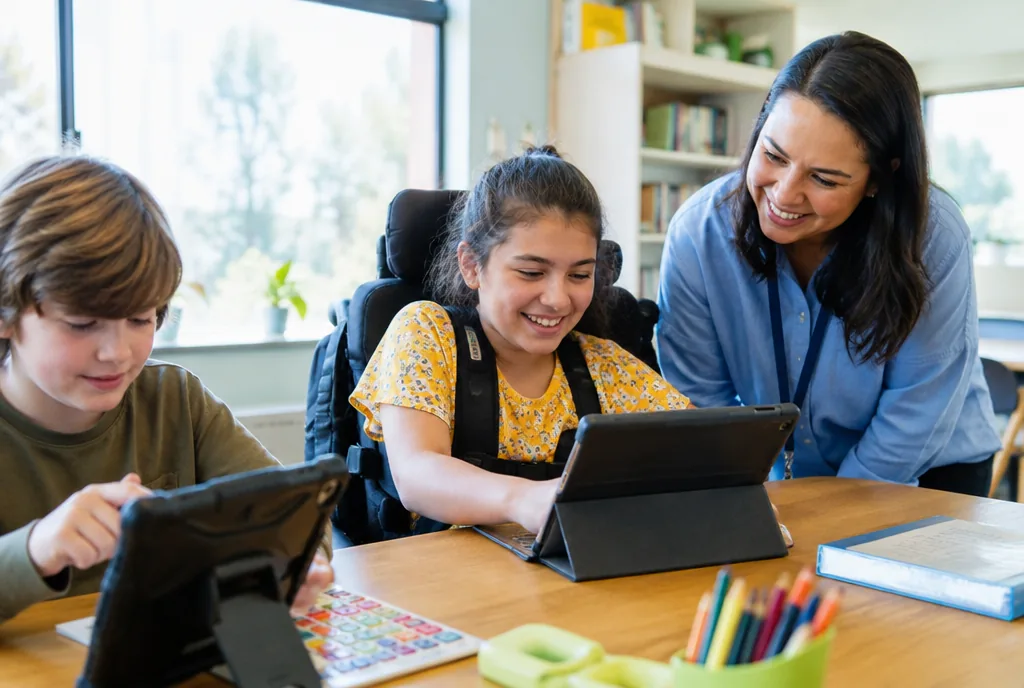
UDL stands for Universal Design for Learning. It is a modern, proactive educational framework that guides how teachers develop their lesson plans and classroom environments so that all students—regardless of their abilities or disabilities—can learn successfully.
What is Universal Design for Learning?
The concept of UDL originally comes from the world of architecture. In architecture, "universal design" means designing buildings from the very beginning to be accessible to everyone. For example, building a ramp at the entrance of a library helps a person in a wheelchair, but it also helps a parent pushing a stroller and an elderly person with a cane. By designing for the margins, you benefit everyone.
Universal Design for Learning takes this exact concept and applies it to the classroom. Traditionally, teachers planned a single lesson, delivered it in one way (usually a lecture), and tested it in one way (usually a written test). If a student with an IEP failed, the school would retroactively apply special education accommodations to fix the problem. UDL argues that the curriculum itself is broken, not the student. A UDL classroom proactively removes learning barriers from the very start by offering multiple, flexible paths to success.
The three main principles of UDL
UDL is based on extensive neuroscientific research about how the human brain learns. The framework requires teachers to provide flexibility in three specific areas:
- Multiple Means of Representation (The "What" of learning): Students perceive and comprehend information differently. A teacher using UDL will never just hand out a printed textbook chapter. They will provide the text, an audiobook version, a video explaining the concept, and a highly visual graphic organizer, allowing students to consume the information in the way their brain processes best.
- Multiple Means of Action and Expression (The "How" of learning): Students navigate learning environments differently. Instead of forcing every child to take a high-stakes, multiple-choice written test to prove they learned about the Civil War, a UDL teacher offers choices. A student can write an essay, build a physical diorama, record a podcast, or create a digital slide presentation to demonstrate their knowledge.
- Multiple Means of Engagement (The "Why" of learning): Students are motivated differently. What excites one child will deeply bore another. UDL classrooms offer choices that tap into students' interests, provide varied levels of challenge, and build a safe environment that reduces anxiety and increases self-regulation.
UDL vs. Special Education Accommodations
It is important to understand the difference between UDL and traditional special education accommodations, like those found in an IEP or a 504 plan.
An accommodation is reactive and individualized. If a student is legally blind, an accommodation forces the school to retroactively translate the standard textbook into Braille specifically for that one child. UDL is proactive and universal. In a UDL environment, the materials are completely digital and accessible from day one, allowing any student—the blind student, the dyslexic student, or the general education student who just prefers listening—to use text-to-speech software without needing to ask for special permission.
Why UDL benefits all students
While UDL is highly beneficial for students with disabilities, it is a general education initiative that raises achievement for everyone. By removing the stigma of "special tools for special kids," UDL normalizes the idea that everyone learns differently. A student who does not have an IEP but suffers from severe test anxiety benefits immensely when given the option to record a video presentation instead of taking a written exam. English Language Learners (ELLs) thrive when lessons include heavy visual representation and captioned videos.
What parents can do
During Parent-Teacher conferences or IEP meetings, ask the school staff how they incorporate Universal Design for Learning in the general education classroom. If your child frequently acts out during math or refuses to do writing assignments, ask the teacher if there are alternative ways your child can show what they know.
If you see a teacher utilizing UDL strategies—like letting the class choose between three different project formats or using flexible seating—praise them. Encourage the school administration to provide UDL training for all general education teachers, as it is the most effective way to ensure students with disabilities are successfully included in mainstream classrooms.
Key points for parents
- Universal Design for Learning (UDL) is an educational framework that proactively removes barriers to learning for all students.
- It is based on the idea that the curriculum should be flexible from the start, rather than retroactively fixing it for a student with a disability.
- UDL offers multiple ways for students to consume information, demonstrate their knowledge, and stay engaged in the lesson.
- Unlike an IEP accommodation, which is specific to one child, UDL strategies are available to every single student in the classroom.
- Parents should encourage teachers to provide choices in assignments so children can use their natural strengths to show what they have learned.