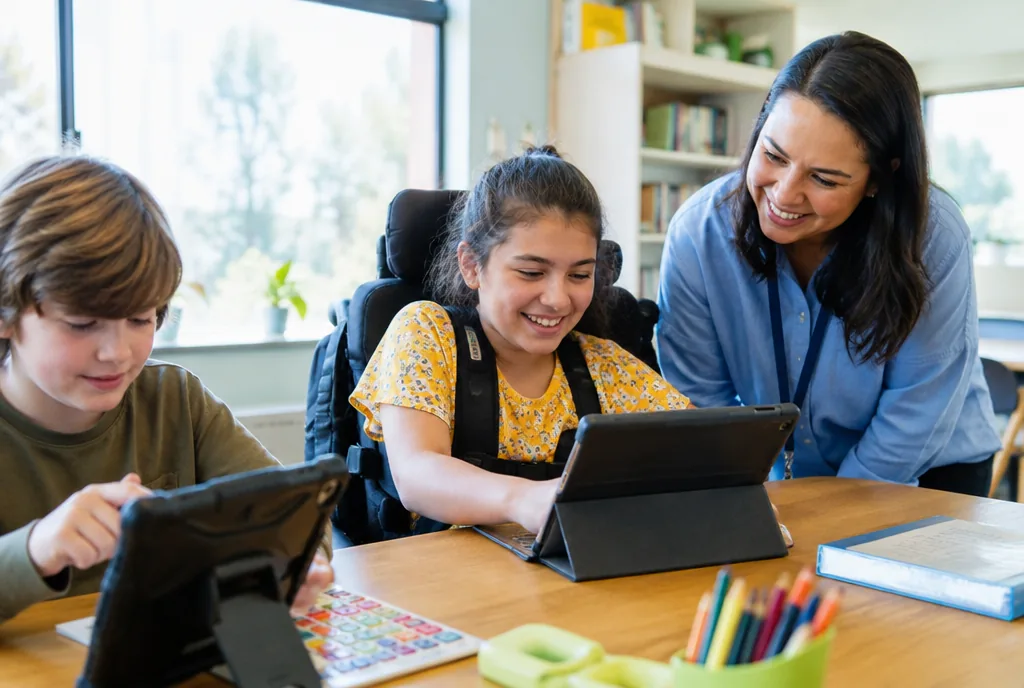
AAC, or Augmentative and Alternative Communication, encompasses all the various methods, tools, and systems used to help individuals communicate when they are unable to rely solely on natural speech. It is a vital area of support within the realm of special education for children who may be non-verbal, have limited verbal abilities, or experience significant speech-language challenges. By providing an alternative avenue for expression, AAC ensures that every child has a voice, can participate actively in their education, and can connect with their peers and family members. It is a critical component for many students to access their FAPE and truly benefit from their educational environment.
The Spectrum of AAC Systems
When parents first hear about AAC, they often picture complex computerized devices. While high-tech options certainly exist, AAC actually exists on a broad spectrum ranging from no-tech to high-tech. "No-tech" or "unaided" AAC includes body language, facial expressions, gestures, and sign language. Because these methods require no external tools, they are always available to the child and are often the foundational building blocks for more advanced communication.
"Low-tech" or "light-tech" AAC systems involve external tools but do not require batteries or electricity. Examples include picture exchange communication systems, communication boards, alphabet boards, and simple symbol books. These are often highly durable, visually straightforward, and serve as an excellent starting point for young children or those just beginning to learn how to communicate intentionally with others. They are especially useful in environments where electronic devices might be impractical, such as during water play or outdoor activities.
"High-tech" AAC involves electronic devices, often with speech-generating capabilities. These can be dedicated communication devices prescribed by a medical professional or standard tablets equipped with specialized, robust communication applications. High-tech systems can be customized extensively, allowing the child to construct complex sentences, express nuanced feelings, and navigate different social contexts. These devices often grow with the child, offering vast vocabularies that can be expanded as the child's language skills develop.
The Role of the Speech-Language Pathologist
Implementing an AAC system is rarely a simple task of handing a device to a child and expecting them to know how to use it. The evaluation and training process is heavily guided by an SLP who has specific expertise in augmentative communication. The SLP conducts comprehensive assessments to determine which type of system best matches the child's cognitive, physical, and linguistic abilities, ensuring the tool is highly individualized to the student's unique profile.
Beyond the initial selection, the SLP plays an ongoing, crucial role in teaching both the child and the child's communication partners (teachers, parents, and peers) how to use the system effectively. This often involves a strategy called "modeling" or "aided language stimulation," where the adults point to symbols on the AAC device while simultaneously speaking the words, demonstrating to the child how the system works in real-time conversation. The SLP is the driving force behind ensuring the device is integrated functionally into the student's daily routine.
AAC as Assistive Technology in the IEP
Under the federal IDEA, school districts must consider whether a child requires AT to receive an appropriate education. AAC falls squarely under the umbrella of assistive technology. If an IEP team, which includes the parents, determines that a child needs an AAC device to access the curriculum, participate socially, or make progress toward their educational goals, the school district must provide it at no cost to the family.
It is essential for parents to ensure that the AAC device, along with the necessary training for the child and the staff, is explicitly written into the student's IEP. The document should specify when and where the device will be used, who is responsible for programming and maintaining it, and how the staff will support its use across different environments, including the general education classroom. Vague promises are not enough; the IEP must be highly specific to legally bind the school to provide these essential communication services.
Overcoming Common Myths and Barriers
A persistent and damaging myth surrounding AAC is the fear that introducing a communication device will prevent a child from developing natural speech. Extensive research has consistently shown the exact opposite: using AAC does not hinder speech development, and in many cases, it actually supports and encourages verbalization. Waiting for a child to prove they are "ready" for AAC can result in years of severe frustration and lost learning opportunities. Communication is a fundamental human right, and providing a tool for expression should never be delayed.
Another common barrier is the abandonment of the device. This often happens when a child is given a device but neither the child nor the school staff receives adequate training on how to integrate it into daily life. For an AAC system to be successful, it must be embraced not just in the therapy room, but consistently throughout the school day, at home, and in the community. Parents must actively advocate to ensure that all teachers and paraprofessionals working with their child are fully trained and comfortable utilizing the system.
Key points for parents
- AAC includes any tool or method used to supplement or replace spoken language, ranging from simple gestures to advanced speech-generating tablets.
- Using an AAC device will not stop your child from developing natural speech; research shows it can actually encourage vocalization and reduce frustration.
- An SLP is the primary professional responsible for evaluating your child's AAC needs and providing the necessary training.
- If your child needs AAC to access their education, the school must provide the device and the associated training as part of their IEP at no cost to you.
- Consistency is critical; ensure the IEP mandates that all school staff working with your child are trained on the device so it is used throughout the entire school day.