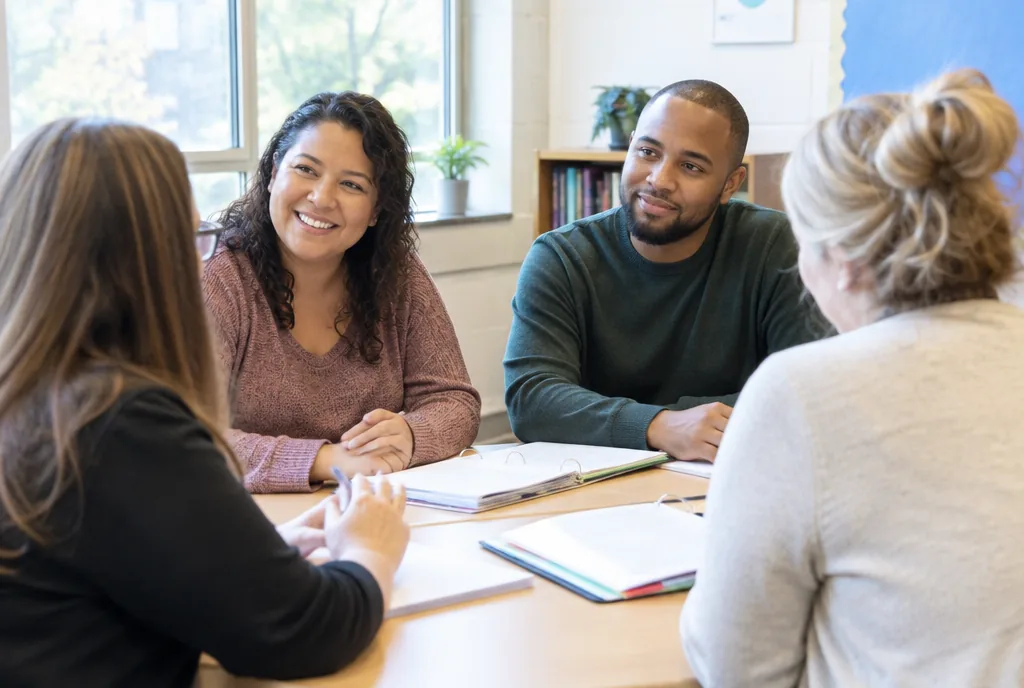
A paraprofessional is a trained school staff member who works alongside teachers to support students, but who is not a licensed teacher. Paraprofessionals help with instruction, behavior support, personal care, and classroom tasks, always under the supervision of a certified teacher. In special education, a paraprofessional often helps students with disabilities take part in class and make progress on the goals in their IEP.
Paraprofessionals go by many names: paraeducator, para, teacher's aide, teacher assistant, teaching assistant, instructional aide, or educational assistant. When a paraprofessional is assigned to work with one student for most or all of the school day, parents and schools often call this a 1:1 aide or one-on-one aide.
What is a paraprofessional in special education?
Paraprofessionals work in many settings: general education classrooms, special education classrooms, resource rooms, preschool programs, lunchrooms, playgrounds, and on the school bus. Some support a whole class. Others support a small group of students or one student with high needs.
A paraprofessional in special education helps carry out the plan the IEP team has written. They do not design the plan. The special education teacher and the IEP team decide what the student needs. The para helps deliver that support day to day, so the student can learn in the least restrictive environment.
What do paraprofessionals do?
Duties depend on the student, the classroom, and the school district. Common tasks include:
- Instructional support: reviewing or reinforcing a lesson the teacher has already taught, working with small groups of students, reading aloud, and helping a student stay on task.
- Accommodations: providing the supports listed in the IEP or 504 plan, such as reading test questions aloud, acting as a scribe, or giving breaks. (See accommodations vs. modifications.)
- Behavior support: following a behavior intervention plan, giving positive feedback, and collecting behavior data for the teacher.
- Communication support: helping a student use an AAC device or other assistive technology.
- Personal care and safety: help with toileting, feeding, moving between classes, or supervision for students with medical or safety needs.
- Data collection: tracking progress on IEP goals so the teacher can report it.
- Classroom support: preparing materials, helping with classroom management, supervising at lunch or recess, and helping with transitions.
What a paraprofessional should not do is also important. A para should not plan lessons alone, teach brand-new content without a teacher's direction, make decisions about the IEP, or replace the services of a special education teacher or related-service provider such as a speech-language pathologist.
Paraprofessional requirements
Requirements depend on where the paraprofessional works and on state law. For paraprofessionals with instructional duties in schools or programs funded by Title I, federal rules have long set this standard: a high school diploma or equivalent plus one of the following:
- At least two years of study at a college or university,
- An associate degree or higher, or
- Passing a formal state or local assessment that shows knowledge of, and ability to help teach, reading, writing, and math (or readiness skills in those areas).
The Every Student Succeeds Act (ESSA) also requires that paraprofessionals in Title I programs meet any state certification and licensure requirements. IDEA says states must make sure that paraprofessionals who work with students with disabilities are appropriately trained and supervised, following state law and policy (34 CFR 300.156). Beyond that, rules differ a lot. Some states require a certificate or permit. Some school districts require additional training in behavior support, first aid, CPR, or safe restraint, and many offer professional development for paraprofessionals. Parents who want details should ask their district or state department of education.
How to become a paraprofessional
The requirements to become a paraprofessional vary by state and district, but the path usually looks like this:
- Earn a high school diploma or GED.
- Meet the Title I standard if the job includes instruction: two years of college credits, an associate degree, or a passing score on an approved test. Many states use the ETS ParaPro Assessment for this.
- Complete any state certificate, background check, or district training that is required.
Many paraprofessionals start as a substitute paraprofessional or in a part-time role before taking a full-time position. Pay and benefits are set by each district or union contract, so they differ widely. Some paras later go on to earn a teaching license.
Supervision by teachers
Paraprofessionals must work under the supervision of a certified teacher. In practice, this means the teacher plans the instruction, tells the para what to do and how to do it, and checks the student's progress. The para should not be left in charge of a student's whole education.
Good teamwork between teacher and para makes a big difference. Helpful habits include short regular meetings, clear written instructions, sharing the IEP goals and accommodations with the para, and training on the student's specific needs. A para who knows the goals can give much better support than one who is simply told to "help."
1:1 aides in the IEP
Some students need a dedicated one-on-one aide. This can happen when a student has significant medical, safety, behavior, or personal care needs, or needs constant support to take part in a general education class. Students with autism, significant physical disabilities, or complex health needs sometimes have a 1:1 aide, but the decision is always based on the individual student.
A 1:1 aide is usually written into the IEP as a supplementary aid and service. The IEP should explain what the aide will do, when, and for how many minutes or hours. Because it is in the IEP, the school must provide it; it cannot be removed without an IEP team decision.
A 1:1 aide is not always the best answer. Too much adult help can lead to over-dependence, fewer friendships with peers, and less independence. Many IEP teams plan to fade support over time and teach the student to do more on their own. A good plan names the skills the student is working toward so the aide can step back as the student grows.
How parents can ask for a paraprofessional or aide
If you think your child needs more adult support, you can ask. Here are practical steps:
- Put the request in writing. Send it to the special education teacher or case manager and ask for an IEP meeting.
- Describe the need, not just the solution. Explain what is happening, for example safety concerns, missed instruction, or behavior incidents. Share notes, emails, or reports from doctors or therapists.
- Ask for data or an evaluation. The school may do a functional behavior assessment or an observation to see how much support your child needs.
- Ask how the support will be written. If the team agrees, check that the IEP lists the type of support, the setting, and the time. If the team says no, the school must give you prior written notice explaining why.
- Know your rights. If you disagree, your procedural safeguards describe options such as mediation or a due process complaint.
Frequently asked questions about paraprofessionals
Is a paraprofessional the same as a teacher's aide?
Mostly, yes. "Teacher's aide," "paraeducator," "instructional aide," and "para" are common names for the same kind of job. Exact titles and duties vary by district.
Do paraprofessionals need a degree?
Not always. Paras with instructional duties in Title I programs need a high school diploma plus two years of college, an associate degree, or a passing score on a formal assessment. Other positions may have different state or district requirements.
Can a paraprofessional teach a class?
No. A paraprofessional may support and reinforce instruction, but a certified teacher must plan the lessons and supervise the para's work.
How do I get a 1:1 aide for my child?
Ask for an IEP meeting in writing, explain your child's needs with examples and data, and ask the team to consider a 1:1 aide as a supplementary aid and service. The IEP team decides, and you have the right to disagree through your procedural safeguards.
Can a paraprofessional work with a student on a 504 plan?
Yes. A para can provide accommodations listed in a 504 plan, such as reading directions aloud or supervising breaks, if the school assigns that support.