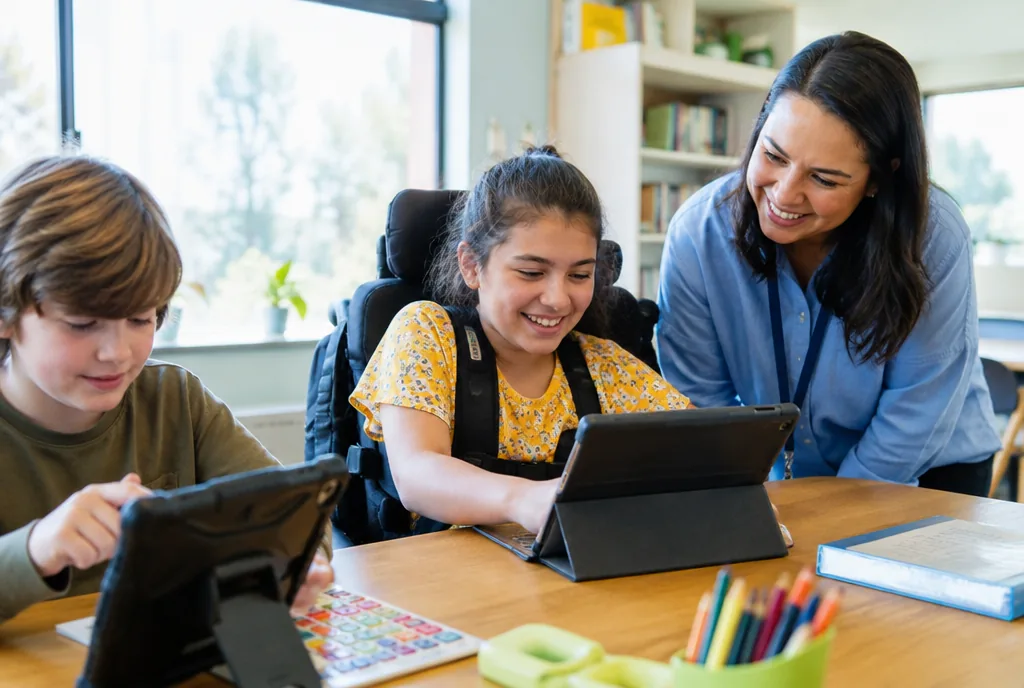
An SLP is a Speech-Language Pathologist, commonly referred to as a speech therapist. In the school setting, an SLP is a highly trained specialist who evaluates and treats students with communication disorders that negatively impact their educational performance.
What does an SLP do in schools?
Communication is the absolute foundation of the school experience. A child must be able to listen to instructions, process academic information, express their thoughts, and interact with peers. When a disability interrupts any part of this process, a Speech-Language Pathologist is brought in as a related service provider under the IDEA.
Many parents assume that speech therapists only help children who lisp or stutter. While correcting articulation is an important part of the job, a school SLP's role is vastly broader. They treat the entire spectrum of language and communication, ensuring that a student can meaningfully participate in their IEP and access the general education curriculum.
The four main areas of Speech-Language Therapy
If your child qualifies for speech therapy, the SLP will typically focus on one or more of these distinct areas:
- Articulation and Fluency (Speech): This is the physical production of sounds. It includes helping children properly pronounce specific letters (like R or S), treating stutters, and helping students whose speech is highly difficult for strangers to understand.
- Receptive Language: This is a child's ability to understand the information they hear. An SLP helps students who struggle to follow multi-step directions, comprehend a story read aloud, or process complex vocabulary in the classroom.
- Expressive Language: This is a child's ability to express their thoughts and needs. An SLP assists students who have trouble putting sentences together, using correct grammar, or explaining a sequence of events.
- Social Pragmatics: This is the social use of language. Very common for students with Autism Spectrum Disorder, pragmatics involves teaching the "unwritten rules" of conversation—such as how to take turns talking, how to maintain eye contact, how to stay on topic, and how to read the body language of peers.
Additionally, for non-speaking students, an SLP is the primary expert in AAC (Augmentative and Alternative Communication). They evaluate and teach children how to use picture boards, sign language, or high-tech speech-generating devices (like an iPad app) to communicate their needs.
Medical vs. Educational Speech Therapy
Just like occupational therapy, there is a legal difference between private medical speech therapy and school-based speech therapy. To qualify for an SLP in a public school, the child's communication delay must have a direct, adverse effect on their educational performance.
For example, if a child has a slight lisp when saying the "s" sound, but they have plenty of friends, read at grade level, and willingly participate in class, they may not qualify for school-based therapy because the lisp is not harming their education. However, if a child's speech is so difficult to understand that they refuse to read aloud, become frustrated and act out, or fail to make friends, the communication disorder is clearly affecting their education, and the school must provide services.
How SLP services are delivered
Speech therapy can be provided in different formats depending on the child's needs. The most traditional model is "pull-out," where the SLP takes the student (often in a small group of 2 or 3) to a quiet therapy room to practice specific sounds or grammar drills without classroom distractions.
Increasingly, SLPs use a "push-in" model. The therapist comes directly into the general education classroom to support the student during a live lesson. For example, the SLP might join a reading group to help the student formulate verbal answers to a story in real-time. SLPs also frequently consult with the general education teacher to ensure classroom instructions are being delivered in a way the student can process.
What parents can do
If you suspect your child is struggling to communicate, understand directions, or socialize with peers, submit a written request for a Speech and Language evaluation. Be sure to provide the school with any private medical evaluations or hearing tests you have already completed.
Once your child receives services, communication with the SLP is essential. Speech and language skills require immense practice to master. Ask the SLP for simple, practical activities you can do at home—during car rides or dinner time—to reinforce the exact sounds, vocabulary words, or social skills your child is working on that week.
Key points for parents
- A Speech-Language Pathologist works on both the physical production of speech (sounds/stuttering) and the complex processing of language.
- SLPs are crucial for teaching social pragmatics to students who struggle with the unwritten rules of conversation.
- To qualify for school-based SLP services, the communication issue must negatively affect the child's educational performance.
- SLPs are the lead experts in evaluating and teaching students how to use augmentative communication devices (AAC).
- Consistent practice at home is vital for speech and language progress, so parents should regularly ask the SLP for homework strategies.