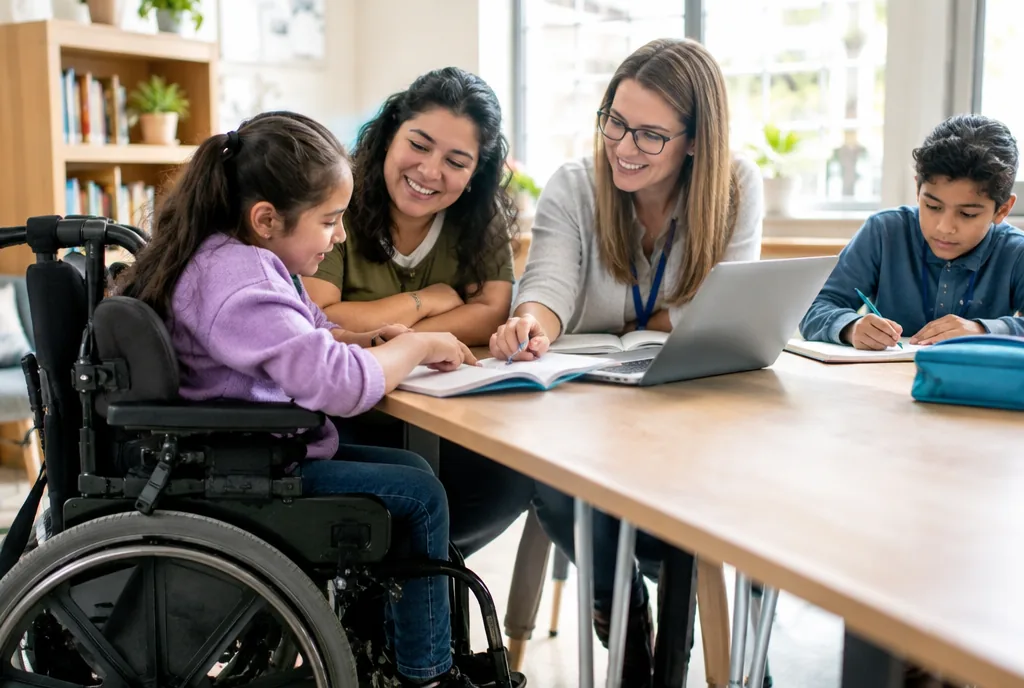
An orthopedic impairment can change how a student moves through school, writes an answer, uses a lab table, or lasts through a full day. Under IDEA, however, orthopedic impairment has a specific meaning: it is a severe orthopedic impairment that adversely affects a child’s educational performance. That distinction matters. A diagnosis may explain a student’s needs, but the school team must also look at what happens during learning and whether the student needs specially designed instruction.
What orthopedic impairment means under IDEA
IDEA’s definition appears in 34 CFR § 300.8(c)(8). It covers a severe orthopedic impairment that adversely affects educational performance. The regulation includes impairments caused by a congenital anomaly, disease, or other causes. Its examples are broad: poliomyelitis and bone tuberculosis as impairments caused by disease, and cerebral palsy, amputations, and fractures or burns that cause contractures as impairments from other causes. Congenital anomalies such as clubfoot or a missing limb fall under the first group.
Orthopedic impairment is one of the 13 disability categories in IDEA Part B and is also considered a low-incidence category. In school conversations, the phrase mobility disability is often used alongside OI. The terms overlap, but they are not identical: OI is the specific IDEA category, while mobility disability is broader.
The key phrase is adversely affects educational performance. A student may have an orthopedic diagnosis and still not need an IEP under OI. Conversely, educational impact is not limited to a report card. Difficulty getting to class, completing written work, using materials, sustaining effort, or joining required activities can show how a physical impairment affects school.
Which conditions can fit the OI special education category
The category is organized around the impairment and its educational effect, not around one fixed list of diagnoses. It can include neuromotor impairments such as cerebral palsy or spina bifida, degenerative conditions such as muscular dystrophy, and musculoskeletal conditions such as juvenile rheumatoid arthritis. Functional needs can range from full-time wheelchair use to a mild gait difference.
| Type described in IDEA | Examples | What the school still needs to consider |
|---|---|---|
| Congenital anomaly | Clubfoot; missing limbs (common examples, not named in the current text) | How mobility, positioning, writing, or participation affects educational performance |
| Impairment caused by disease | Poliomyelitis; bone tuberculosis | Whether the condition creates barriers that require specially designed instruction |
| Other causes | Cerebral palsy; amputation; fractures or burns causing contractures | The student’s actual access, stamina, and learning needs at school |
Cerebral palsy is an orthopedic impairment under IDEA when it meets the educational-impact standard. It is expressly named in the federal definition and is widely described as the most common condition identified under OI; one estimate puts it at about 80% of OI cases. CP is a non-progressive motor disorder caused by a static brain injury before, during, or shortly after birth. A student may have stiffness, involuntary movements, balance and coordination difficulties, or a combination of these needs.
Scoliosis can be an orthopedic impairment, but it is not automatically an IDEA eligibility category. The question is whether its severity adversely affects educational performance. Pain, limited ability to sit, or reduced endurance may be relevant when they interfere with classroom work or participation.
How orthopedic impairment can affect learning and participation
OI does not describe a student’s intelligence or potential. It describes physical barriers that can make ordinary school tasks take more time, energy, or support. A student may understand a lesson fully yet struggle to show that knowledge on paper, move between rooms, or stay positioned comfortably long enough to complete an assignment.
- Fine-motor barriers: writing, using scissors, typing, holding a book, or manipulating classroom tools can be slow or difficult.
- Gross-motor and mobility barriers: walking, climbing stairs, balancing, and moving around a classroom may affect transitions, group work, PE, and field trips.
- Stamina and physical symptoms: pain, spasticity, reduced coordination, and decreased endurance can affect concentration and the need for breaks.
- Interrupted instruction: medical appointments, therapy, surgery, and recovery can lead to missed class time and learning gaps.
For example, a student with reduced grip strength may know the answer to a science question but cannot handwrite it at the same pace as classmates. Another student may arrive late to a distant classroom because using a mobility device takes additional time, especially in poor weather. These are access issues the team can describe and address; they are more useful than assuming a need from the diagnosis alone.
Some students with severe motor limitations have fewer opportunities to explore and interact with their environment, which can contribute to delayed cognitive-language development. Others have motor needs without additional language or cognitive needs. When speech or hearing needs occur alongside severe CP, augmentative and alternative communication may be important.
How schools determine whether an IEP is needed
For OI special education eligibility, a medical diagnosis by itself is not enough. The IEP team considers whether the orthopedic impairment adversely affects educational performance and whether the student needs specially designed instruction. Parents, teachers, a school psychologist, a special educator, and, when appropriate, a physician can contribute to the evaluation.
- Document the condition. Medical records or a physician report describe the orthopedic impairment.
- Assess school function. Fine- and gross-motor testing, educational assessment, and, when needed, occupational therapy and physical therapy assessments identify barriers in the learning environment.
- Connect the evidence to school. The team examines how the impairment affects classroom tasks, participation, and educational progress.
- Decide on the support pathway. A student who needs specially designed instruction may be eligible for an IEP. Another student may need accessibility and accommodations through a 504 plan rather than an IEP.
State criteria can add detail. Tennessee, for example, requires evidence of a severe orthopedic impairment from a physician, evidence that the student cannot make reasonable educational progress without special instruction, and that another disability category is not primary. The process is comprehensive because an orthopedic label alone cannot show what a particular student needs in class.
Choose accommodations by the barrier, not the diagnosis
Accommodations should match a specific school barrier. If fatigue makes a timed test unrealistic, extra time and a separate testing space may help. If a student cannot take notes while listening, a note taker, peer notes, a recording device, or a laptop can preserve access to the lesson. The goal is to remove the barrier while keeping the learning task clear.
- Preferred seating, accessible classrooms, ramps, elevators, wide doors, and accessible parking can make entry and movement possible.
- Extra transition time and accessible field-trip planning recognize that travel can take longer.
- Extended test time, a separate room, a scribe, and word processing can support students who need more time or another way to produce work.
- Adjustable lab or drafting tables and lab assistance can make science and technical courses usable.
- Adapted activities and adaptive equipment can support participation in physical education.
Consider a student who uses a wheelchair and can complete the same science investigation as peers once the workstation is the right height. The educational target is not reduced; the physical route to the task changes. That is the practical purpose of accessibility planning.
Use assistive technology to create another way to participate
Assistive technology is most effective when the team starts with a task: What is preventing this student from communicating, writing, moving, or using a computer? Mobility equipment may include manual or power wheelchairs, walkers, crutches, braces, splints, gait trainers, standing frames, and adaptive seating. Orthoses and supportive footwear can improve mobility, stability, and strength for students with CP and neuromuscular conditions.
For fine-motor tasks, adaptive writing tools and specialized scissors can make writing and classroom projects more manageable. Speech-to-text, word prediction, keyboard adaptations, and on-screen keyboards offer different ways to produce written work. For students with severe motor impairments, speech-generating devices and switch or button systems can support communication and computer access.
A pencil is not the learning goal when the assignment is to explain a historical argument. A student who uses speech-to-text or a keyboard can still organize evidence and communicate reasoning. Likewise, a student who uses a speech-generating device can participate in a discussion even when spoken speech is difficult.
Replace common myths with better questions
Myth: Every orthopedic diagnosis leads to an IEP. IDEA requires a severe orthopedic impairment that adversely affects educational performance, and the student must need specially designed instruction. Some students need an IEP; others need a 504 plan or accessibility supports.
Myth: OI is only about wheelchair use. The category includes a wide range of physical impairments, from mild gait differences to extensive motor needs. The useful question is, “Which school task is difficult, and what would make it accessible?”
Myth: An accommodation lowers expectations. A laptop, extra transition time, accessible lab table, or adaptive PE equipment may change the route to participation. They do not automatically change the skill or knowledge being assessed.
Myth: Mobility is the only educational concern. Pain, fatigue, handwriting, communication, absences, and access to materials can all shape a student’s day. A plan that addresses only the doorway can miss the work that happens after the student enters the room.
Frequently Asked Questions
What is an orthopedic impairment?
Under IDEA, it is a severe orthopedic impairment that adversely affects a child’s educational performance. The federal definition includes impairments from congenital anomalies, disease, and other causes.
What is an example of an orthopedic impairment?
IDEA names poliomyelitis, bone tuberculosis, cerebral palsy, amputations, and fractures or burns that cause contractures. Congenital anomalies such as clubfoot or a missing limb are also covered. Whether a student qualifies under OI depends on educational impact and need for specially designed instruction.
Is cerebral palsy an orthopedic impairment?
Yes. Cerebral palsy is explicitly included in 34 CFR § 300.8(c)(8). A student with CP may qualify under OI when the impairment adversely affects educational performance and the student needs specially designed instruction.
Is scoliosis an orthopedic impairment?
It can be, but not automatically. The school team must consider whether scoliosis is severe enough to affect educational performance, including through pain, difficulty sitting, or reduced endurance.
How does orthopedic impairment affect learning?
It can affect writing, typing, holding books, moving around school, stamina, concentration, attendance, and participation in PE or field trips. Accommodations, accessibility measures, and assistive technology can address specific barriers.