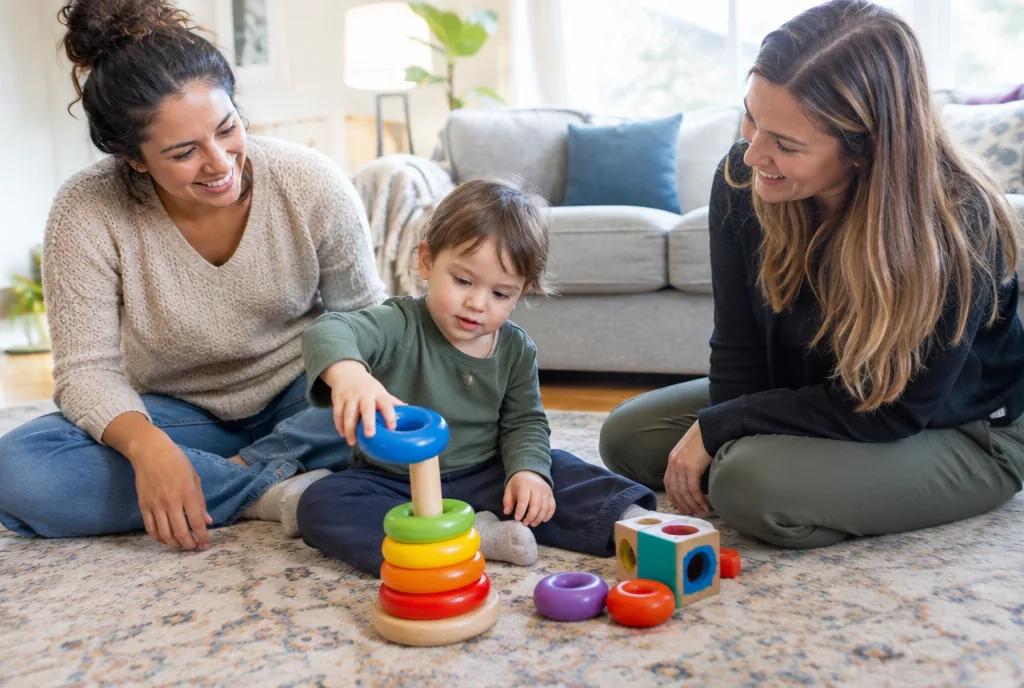
An IFSP, or Individualized Family Service Plan, is the written, family-centered plan used in early intervention under IDEA Part C for eligible children from birth through age 2. It does more than list appointments: it records what your child is doing now, what your family wants to work toward, which services will help, and how those services fit into everyday life. That difference matters when you are trying to turn a referral into practical support.
What an IFSP means in early intervention
IFSP stands for Individualized Family Service Plan. It is the central plan for early intervention, the IDEA Part C program for infants and toddlers with disabilities. In 2023, 460,321 infants and toddlers received Part C services in the 50 states and the District of Columbia—4.2% of the resident population in that age group.
The IFSP is family-centered. In other words, the family is not simply asked to approve a professional plan for a child; the plan addresses outcomes for both the child and the family. A family may want support for a daily routine, communication, participation in child care, or another concern identified through the family assessment. The exact outcomes belong in the written plan.
Every family with an IFSP has a service coordinator. This person helps with assessment, coordinates the plan, and supports transitions. The coordinator is the one person who must be identified in the IFSP by name and telephone number. When a parent, teacher, or provider has a question about the plan or what happens next, that named contact is a useful place to start.
Early intervention was not part of the original 1975 federal special education law. Infants and toddlers under age 3 were added in 1986. That history helps explain why the IFSP is built around family life before school begins rather than around a school program.
Who may qualify for Part C services—and what happens after a referral
A child may be eligible for Part C when the child has a developmental delay or a diagnosed physical or mental condition with a high probability of causing a developmental delay. States may also choose to serve children considered at risk, but those definitions vary by state. Each state operates a Child Find system to identify infants and toddlers who may benefit from early intervention.
The required evaluation considers five developmental areas:
- cognitive development;
- physical development, including vision and hearing;
- communication;
- social-emotional development; and
- adaptive development.
From the date of referral, the early intervention system generally has 45 calendar days to complete screening, the initial evaluation, the family assessment, and the first IFSP meeting. The limited exceptions involve documented exceptional family circumstances, such as a child’s hospitalization, or a parent’s lack of consent despite repeated attempts to obtain it. In those cases, an interim IFSP may be used so that support does not stop completely while the full evaluation is unfinished.
For a parent, the practical sequence is straightforward: make or accept the referral, participate in the evaluation and family assessment, attend the initial meeting, and read the written plan before consenting to services. For a teacher or child care provider, a useful role is to share specific observations about routines and participation rather than to guess whether a child qualifies. Family participation is required, and an IFSP cannot be implemented without parental consent.
What belongs in an IFSP before you agree to it
An IFSP must be written. Its required pieces turn a broad concern into a plan you can check. It includes the child’s current developmental level, the results of the family assessment, desired outcomes for the child and family, and the early intervention services to be provided, including their frequency and duration.
Each service entry needs enough detail to answer the practical questions that otherwise create confusion later:
| What the plan must identify | What you can look for in the written IFSP |
|---|---|
| Service details | The type of service, when it begins, and its duration in days |
| Schedule | Frequency and intensity, such as the number of sessions per week or month |
| Delivery method | Whether the service is individual or group-based |
| Location | Where the service will be provided |
| Coordination | The service coordinator’s name and telephone number |
Location is not a minor detail. Part C emphasizes services in a natural environment: a setting that is natural or typical for a same-aged infant or toddler without a disability. Home, child care, and a playgroup are familiar examples. If a service will not occur in a natural environment, the IFSP must explain why. That requirement keeps the conversation focused on where a young child actually spends time, not only on a service label.
Imagine a family whose concern is that everyday communication is difficult during meals, play, and child care drop-off. A useful IFSP discussion connects the child’s present communication skills, the family’s priorities, a desired outcome, and the precise service details. The plan should make clear where the service happens, how often it occurs, and who can answer questions—not leave the family with a vague promise of help.
IFSP vs. IEP: why the plan changes at age 3
IFSP vs. IEP is not merely a change in initials. The plans serve different age groups and organize support around different centers of gravity. An IFSP applies from birth through age 2 under IDEA Part C. An IEP, or Individualized Education Program, applies beginning at a child’s third birthday under Part B.
| IFSP | IEP |
|---|---|
| Family-centered | Child-centered |
| Outcomes for the child and family | Annual goals for the child |
| Birth through age 2 under Part C | Begins at age 3 under Part B |
| Requires a service coordinator | Uses a case manager rather than a service coordinator |
| Usually delivered in natural environments | Implemented in the least restrictive environment |
| Developed by a multidisciplinary team | Requires a special educator as a team member |
Neither plan is a lesser version of the other. The IFSP recognizes that a baby or toddler’s learning is inseparable from family routines and the places young children typically go. The IEP addresses a child as a student and is connected to the right to a free appropriate public education. For teachers, this distinction clarifies why an IFSP conversation may include family outcomes, while an IEP centers annual educational goals for the child.
Use reviews and transition planning before deadlines create pressure
An IFSP must be reviewed at least every six months. You can ask for an earlier review at any time. At least once a year, the team must develop a revised IFSP. At a review, the team measures progress toward the outcomes in the plan and can adjust outcomes, change services, or add services.
Do not treat the six-month review as the only moment when the plan can change. If your family’s circumstances or your child’s needs change, you can request an earlier review. Bringing the written plan to that conversation makes it easier to point to the outcome, service, frequency, or location that needs discussion.
Transition deserves attention well before the third birthday. The IFSP must contain a written transition plan, and the transition planning conference must begin no later than 90 days before the child turns 3. By 30 months, transition planning and notice to the local educational agency should already be underway. If the child is not eligible for Part B at age 3, the Part C provider must help connect the family with other community options, such as Head Start, preschool, or early childhood programs.
Common IFSP misunderstandings can derail a useful meeting
An IFSP is just a therapy prescription
No. The IFSP is an outcome-based, family-centered plan. Services are part of it, but the plan also documents the child’s present development, family assessment, outcomes, and the way services will be delivered. Asking only, “Which services will my child get?” can miss the outcome the services are meant to support.
Parents only attend after professionals decide the plan
No. Family participation in IFSP development is required. The plan cannot be implemented without parental consent. A family’s concerns and desired outcomes are therefore part of the plan’s content, not an optional comment at the end of a meeting.
A service outside home or child care needs no explanation
No. The IFSP must justify a service that is not provided in a natural environment. That does not mean every service must occur in the same place; it means the plan has to state why a different setting is needed.
Transition starts on the third birthday
No. The transition planning conference must begin no later than 90 days before that birthday, and planning should be underway by 30 months. Waiting for the birthday leaves little room to understand the next options.
Frequently Asked Questions
What does IFSP stand for?
IFSP stands for Individualized Family Service Plan. It is the family-centered written plan used for eligible infants and toddlers in IDEA Part C early intervention from birth through age 2.
What is the difference between IFSP and IEP?
An IFSP is family-centered and includes outcomes for the child and family; it applies through age 2 under Part C. An IEP is child-centered, uses annual goals for the child, and begins at age 3 under Part B.
What are the key components of an IFSP?
The plan includes the child’s current developmental level, family assessment results, desired outcomes for the child and family, and services. Each service specifies its type, start and duration, frequency and intensity, method, and location.
How often is an IFSP reviewed?
It must be reviewed at least every six months, and a revised IFSP is required at least annually. You may request an earlier review whenever needed.
What does a service coordinator do?
The service coordinator helps with assessment, coordinates the IFSP and services, and supports transitions. The IFSP must name that person and include a telephone number.