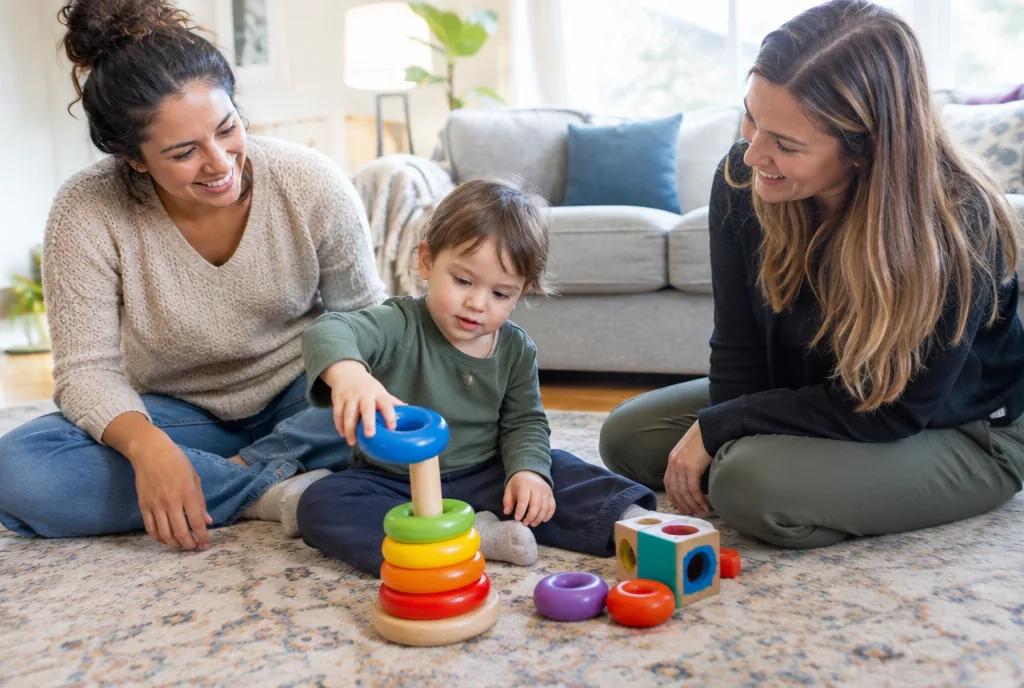
Number sense is the flexible understanding of what numbers mean, how quantities compare, and how numbers can be put together or taken apart. It is what lets a child see that 8 is more than 6, recognize three dots without counting, or notice that a calculator result of 7 × 8 = 5,600 cannot be right. You can build it through short, concrete routines at home or in class—without turning every moment into a worksheet.
What number sense really means
Number sense is not a single skill a child either has or lacks. It is a developing set of abilities: recognizing numbers, connecting them to real amounts, comparing quantities, estimating, and reasoning about operations. A 4-year-old and a 10-year-old may both show number sense, but in very different ways.
Some roots appear remarkably early. At 3 weeks, infants can already tell apart small sets of 1 to 3 objects. That early sensitivity is not the same as learned mathematics, but it gives children something to build on. Experience, language, play, and instruction help turn an early feel for quantity into useful mathematical thinking.
For a parent or teacher, the practical question is not “Can this child recite numbers?” It is “Does this child understand what the numbers stand for?” A child who says “one, two, three, four, five” may know a sequence. A child who hands you exactly five counters when asked is connecting a number word to a quantity.
The building blocks behind flexible math thinking
The Foundational Number Sense Framework describes seven connected components. Looking at them separately makes it easier to notice what a child already understands and where a small amount of support could help.
- Numeral recognition: naming number words and written numerals.
- Systematic counting: counting objects in a dependable way.
- Number-quantity connection: matching a numeral or number word to a set.
- Magnitude comparison: deciding which amount is larger or smaller.
- Estimation: making a reasonable quantity judgment without counting every item.
- Simple operations: understanding that addition increases an amount and subtraction decreases it.
- Number vocabulary: using words such as more, less, equal, and total.
Count objects, then ask what the last number means
Systematic counting has three important parts. In one-to-one correspondence, each object receives one count word. Stable order means the words come in the same sequence every time. Cardinality means the last word spoken tells how many objects are in the whole set.
Put out 8 blocks and 6 blocks. Have the child touch or move each block while counting. Then ask, “How many are there?” rather than accepting a repeated count as the whole answer. Finally ask which group has more. That one exchange connects counting, cardinality, and comparison instead of treating them as isolated drills.
Let a number line reveal relative size
Estimation is another window into number sense. Ask a child to place 47 on a blank line marked 0 at one end and 100 at the other. The exact placement matters less than the reasoning: Is it near the middle? Is it before or after 50? Young children’s mental number lines are often stretched at the low end and squeezed at the high end, so the distance from 1 to 2 can seem larger than the distance from 8 to 9. With experience, the representation becomes more linear.
Subitizing lets children see small amounts
Subitizing is recognizing a small quantity instantly rather than counting it. For most people, the usual range is 1 to 4 items. When a child sees three dots and says “three” immediately, that is perceptual subitizing.
Conceptual subitizing goes a step further. A child sees 6 as 3 and 3, rather than as six separate dots. That recognition matters because it prepares children to compose and decompose numbers. The pattern in a familiar die face can become a bridge to thinking, “I see 5 and 1, so that is 6.”
| How items are arranged | What often happens |
|---|---|
| Rectangle or grid | Usually easiest to recognize as groups |
| Line or circle | Usually takes more visual scanning |
| Scrambled arrangement | Usually hardest; children may need to count |
Use that difference on purpose. Start with regular dot patterns, then show the same amount in a line, circle, or scattered arrangement. Dice and dominoes are especially useful because their repeated patterns make amounts from 1 to 6 visible at a glance. A quick reveal followed by “How did you know?” is more informative than asking only for the answer.
Number sense is the foundation, not the same as mental math
Mental math means calculating in your head. Number sense is the broader understanding that makes those calculations sensible. It helps a child select a strategy, judge whether an answer is reasonable, and explain why it works. Speed is not the goal; understanding comes first.
Consider 5 + 3 − 3. A child using number sense may see that adding 3 and subtracting 3 cancel each other, leaving 5. Or consider 8 + 7: a child can bridge through 10 by adding 2 to 8 and then 5 more. Neither approach depends on rushing through a memorized procedure.
- Split numbers: turn 14 + 9 into 14 + 6 + 3.
- Compensate: adjust a number to make an easier amount, then correct the adjustment.
- Bridge through 10: use 10 as a landmark for sums such as 8 + 7.
- Use known facts: connect a familiar fact to a related one.
- Estimate: check whether a result fits the size of the numbers.
A 5- to 15-minute Number Talk gives those strategies a place to surface. Present one problem, give students quiet thinking time, and invite several explanations. Instead of announcing one “right way,” record the methods children use. This helps students see that a correct answer can come from more than one sensible path.
Number sense activities that fit into a short daily routine
Brief, repeated practice gives you more useful information than one long session. Choose one activity, keep the prompt clear, and listen for the strategy—not only the final number.
- Flash a ten-frame. Show 0 to 10 dots in a ten-frame for 2 or 3 seconds, hide it, and ask how many the child saw. Show it again and ask what they noticed. A child who sees 7 as 5 and 2 is seeing structure.
- Push beads on a MathRack. A MathRack has two rows of 10 beads, grouped as 5 red and 5 white in each row. Say a number and ask the child to push that many beads in one motion. The one-push rule discourages one-by-one counting and highlights 5 and 10 as anchors.
- Match dot cards. For children ages 3 to 5, hold up a large dot card and ask them to find the matching card on the table. Keep the game to 5 to 10 minutes. Matching patterns and comparing amounts are both part of the work.
- Find a partner that makes 10. Give each player a card from 1 to 9. Players find the person whose card completes 10: 7 finds 3, 4 finds 6. Then reverse the question: “If you have 7, how many are missing?”
- Fill the ten-frame. Roll a die, place that many chips in an empty ten-frame, and ask how many spaces are still empty. The task connects a die pattern, a quantity, and a complement to 10.
- Place a number on a blank line. Mark 0 and 100 on a long line and ask where 47 belongs. Compare the child’s mark with the correct location and talk about the landmarks they used.
Everyday routines work too. Count stairs, set four forks and four knives, or ask whether $5 is likely to cover milk and bread before checking. The useful follow-up is “What makes you think that?” It shifts attention from guessing to quantity and comparison.
Choose math manipulatives that make relationships visible
Math manipulatives work best when they reveal a relationship a child can discuss. More objects are not automatically better. Select one tool, name what the child should notice, and ask them to show the same number another way.
- Ten-frames: A 2-by-5 grid makes 7 look like 5 + 2 and makes the missing amount to 10 visible.
- Rekenreks or MathRacks: Their red-and-white bead groups highlight 5 and 10 without requiring a child to count every bead.
- Cuisenaire rods: The white rod is 1 centimeter and the orange rod is 10 centimeters. Ask a child to build the orange rod with two other rods, then find another combination for 10.
- Base-ten blocks: Units, tens rods, hundreds flats, and thousands cubes make place value visible. Build 47 as 4 tens and 7 ones before asking a child to write it.
- Two-color counters: Lay out 8 counters and turn some red side up and others white side up. Each arrangement shows a different decomposition of 8.
- A floor number line: Let children place number cards, stand at a location, or move forward and backward. Their body movement makes order and distance concrete.
- Dice and dominoes: Use the dot patterns for quick quantity recognition and for composing two amounts.
Follow a simple sequence: prompt, observe, extend. Prompt with one clear task: “Show me 7 in two ways.” Observe whether the child groups by 5, counts one by one, or uses a benchmark. Extend only when the first task is secure: “Now show me how many more make 10.”
When weak number sense calls for closer attention
Look for a pattern over time, not one frustrating day. A child may need closer support when they laboriously count even 1 to 3 objects, cannot reliably give you 5 objects, skip or reverse the counting sequence, confuse written numerals, or cannot tell that 8 is greater than 6. Difficulty comparing a group of 7 dots with a group of 5 dots, avoiding number games, and clear anxiety during math are also worth noticing.
Dyscalculia affects 3% to 7% of children, adolescents, and adults. In a 5-year-old, it can appear as delayed cardinality: the child can say “one, two, three” but does not understand that “three” names the total. Slow or inaccurate recognition of 2 or 3 objects at a glance can also be an early sign. Delayed number-word-to-magnitude connections in preschool are a strong predictor of later math difficulty.
These observations are not a diagnosis. Dyscalculia is not a sign of low intelligence or lack of motivation, and reversed numerals by themselves are common until about age 7. For children ages 4 to 5, ZAREKI-K is a standardized diagnostic instrument. If concerns persist across settings and activities, concrete observations can help guide a conversation with the appropriate professional.
Common myths can hide what a child needs
- “Number sense is just memorizing facts.” Facts can be useful, but number sense is flexible reasoning about quantity, patterns, and relationships.
- “Mental math means fast math.” Mental math rests on strategies such as splitting, compensation, and estimation. A thoughtful explanation matters more than a fast response.
- “Finger counting is always a problem.” Fingers can be a useful early strategy. The concern is not the tool itself but an ongoing inability to use quantities flexibly.
- “A bright child cannot have dyscalculia.” Children with dyscalculia can have average or above-average ability in non-math areas.
- “Reversing a numeral proves dyscalculia.” Reversals through about age 7 are not, on their own, a dyscalculia sign.
Keep the focus on evidence a child can show: Can they match 5 to five objects? Can they see 5 and 2 in a ten-frame? Can they explain why 8 is larger than 6? Those answers point more clearly to next steps than a label or a timed score alone.
Frequently Asked Questions
What is meant by number sense?
Number sense is a flexible understanding of numbers, quantities, comparisons, estimation, and operations. It helps a child know what numbers represent rather than only recite or calculate them.
How can I practice number sense?
Use brief activities with dot cards, ten-frames, dice, a MathRack, or a blank number line. In daily life, ask children to compare amounts, estimate, count objects, and explain their thinking.
Is number sense mental math?
They are closely related but not identical. Mental math is calculation in the head; number sense is the wider understanding of quantity and relationships that makes flexible mental strategies possible.
What does dyscalculia look like in a 5 year old?
A 5-year-old may have trouble understanding cardinality, recognizing 2 or 3 objects quickly, matching number words to quantities, or counting accurately. A pattern of difficulty needs professional assessment; a single sign does not diagnose dyscalculia.
Is finger counting always a problem?
No. Finger counting can support early learning. It is more useful to watch whether a child can also connect fingers to quantities, compare amounts, and gradually use other strategies.